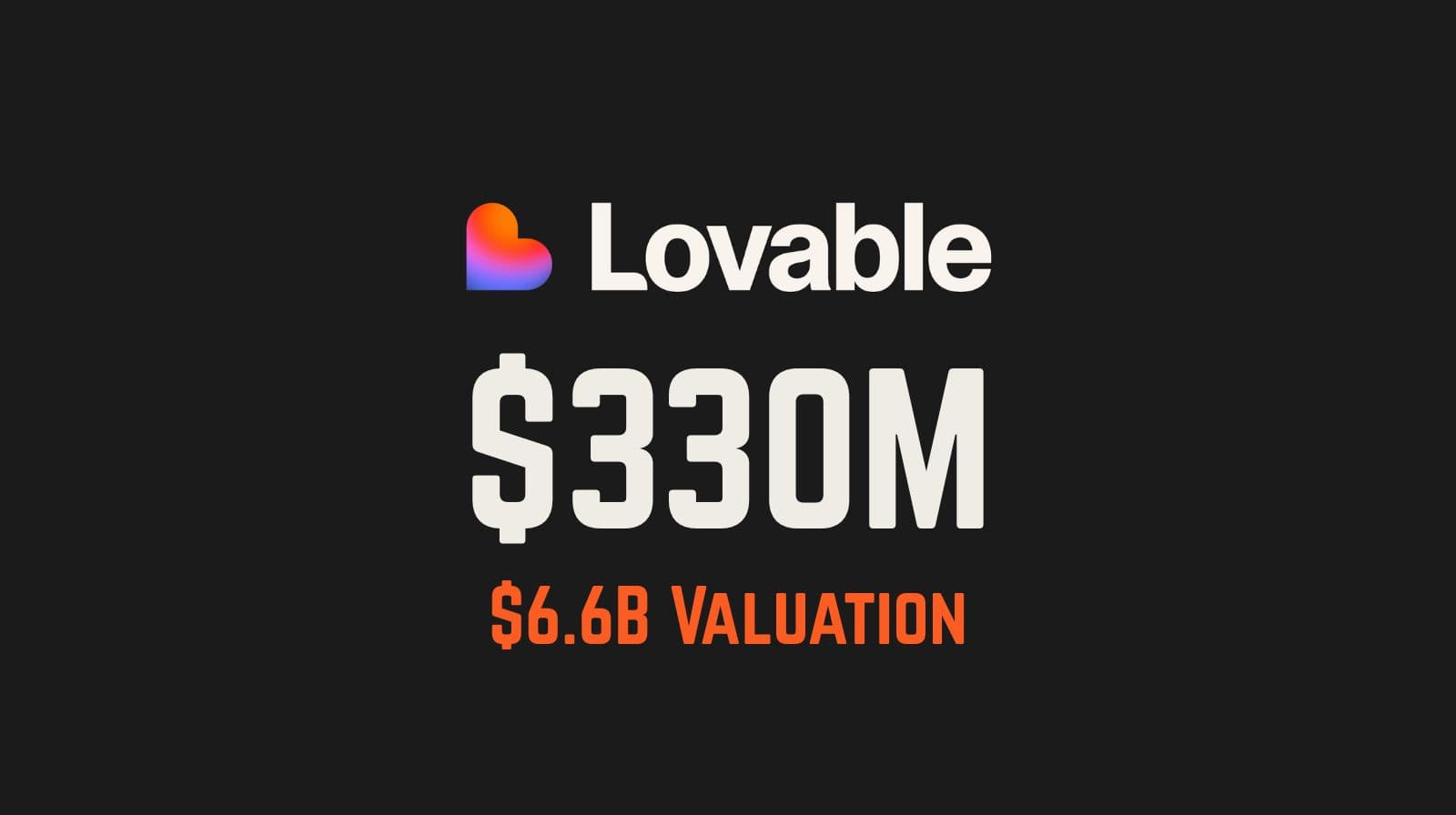
Lovable Secures $330M Series B at $6.6B Valuation
Swedish vibe-coding startup Lovable has raised $330 million at a $6.6 billion valuation, tripling its worth in just five months since its Series A round.
Hasan Wazid
Lovable Secures $330M Series B at $6.6B Valuation
Lovable, a Swedish AI coding platform, raised $330 million in Series B funding at a $6.6 billion valuation. The Stockholm-based startup tripled its valuation in five months, reaching $200 million in annual recurring revenue. CapitalG and Menlo Ventures led the round with participation from major tech investors.
The artificial intelligence boom continues to mint unicorns at breakneck speed. Lovable, a Stockholm-based coding platform, announced Thursday it secured $330 million in Series B funding. This positions the startup at a remarkable $6.6 billion valuation, more than tripling its worth from just five months ago.
CapitalG and Menlo Ventures co-led the funding round. Additional participation came from Khosla Ventures, Salesforce Ventures, and Databricks Ventures. Several other institutional and strategic investors also joined the round, though their names were not disclosed.
Breaking Records in the AI Coding Space
Lovable's meteoric rise stands out even in the fast-moving AI sector. The company raised $200 million in its Series A round this past July. That round valued the startup at $1.8 billion, making it a unicorn overnight.
Five months later, the valuation has jumped 267 percent. This trajectory reflects massive investor appetite for AI-powered development tools. The coding assistance market has become one of the hottest segments in enterprise software.
The startup's revenue growth tells an equally impressive story. Lovable crossed the coveted $100 million annual recurring revenue threshold within just eight months of launching. Four months after that milestone, the company doubled its ARR to surpass $200 million.
These numbers place Lovable among the fastest-growing software companies in history. Few enterprise startups have achieved this velocity, regardless of category or era.
What Makes Vibe Coding Different
Lovable has pioneered what industry insiders call "vibe coding." This approach allows users to describe applications using natural language prompts. The AI then generates functional code and complete applications based on these descriptions.
Unlike traditional integrated development environments, vibe coding eliminates much of the technical complexity. Users don't need extensive programming knowledge to build sophisticated applications. They simply describe what they want the software to do.
The platform handles everything from front-end interfaces to back-end logic. It can integrate databases, payment systems, and hosting infrastructure automatically. This end-to-end approach differentiates Lovable from code completion tools that assist professional developers.
Major enterprise customers have embraced the platform enthusiastically. Klarna, Uber, and Zendesk now count themselves among Lovable's client roster. These brands represent diverse use cases across fintech, transportation, and customer service software.
Impressive Platform Metrics
The company's usage statistics underscore its product-market fit. More than 100,000 new projects launch on Lovable's platform every single day. Over its first year of operation, users created more than 25 million projects total.
These numbers suggest strong retention and expanding use cases. Enterprise customers often start with pilot projects before scaling adoption. The daily project creation rate indicates customers are finding ongoing value beyond initial experimentation.
The platform's ability to support this volume also demonstrates technical maturity. Scaling AI infrastructure to handle millions of code generation requests presents significant engineering challenges.
Strategic Investment in Enterprise Features
Lovable plans to deploy the fresh capital across several strategic priorities. The company will build deeper integrations with third-party applications and services. These connections will make it easier to incorporate Lovable-generated code into existing technology stacks.
Enterprise-specific features will receive increased attention and resources. Large organizations require capabilities like access controls, audit logging, and compliance tools. Building these features properly takes time and specialized expertise.
The startup will also expand its infrastructure offerings significantly. Complete application development requires databases, payment processing, authentication systems, and reliable hosting. Lovable aims to provide all these components natively within its platform.
This vertical integration strategy mirrors successful developer platforms like Vercel and Netlify. By handling infrastructure concerns, Lovable lets users focus entirely on application logic and user experience.
The Silicon Valley Rejection

Lovable's success challenges conventional wisdom about startup geography. Co-founder and CEO Anton Osika made a deliberate choice to keep the company headquartered in Stockholm.
Speaking at the Slush conference in Helsinki this November, Osika addressed the pressure to relocate. Many investors suggested the company would struggle to scale outside Silicon Valley. The traditional tech hubs supposedly offer unique advantages in talent, capital, and customer access.
"It was tempting, but I really resisted that," Osika explained to the conference audience. His conviction proved prescient as the company achieved extraordinary growth from its European base.
Osika believes Stockholm actually provided competitive advantages. "I can sit here now and say, 'Look, guys, you can build a global AI company from this country,'" he stated. The city offers deep technical talent without the fierce competition for engineers that defines San Francisco.
The CEO emphasized mission and urgency as key factors. "There is more available talent if you have a strong mission, and you have a lot of urgency coming together as a group and working," Osika said.
Navigating European Tax Complexity
The rapid growth hasn't been without stumbling blocks. In November, reports surfaced that Lovable had not been paying Value Added Tax on its services. VAT applies to most goods and services sold within the European Union.
Osika acknowledged the oversight publicly in a LinkedIn post. He committed to resolving the situation promptly and ensuring proper tax compliance going forward. The CEO also pushed back against criticism suggesting EU tax complexity hampers startup growth.
Some commenters argued that regulations like VAT make Europe inhospitable for fast-scaling companies. Osika shut down those arguments, defending the company's decision to remain European-headquartered despite regulatory complexity.
The incident highlights challenges facing international startups. Navigating different tax regimes, data privacy laws, and compliance requirements requires significant operational maturity. Growing revenue from $0 to $200 million in under a year can strain administrative capabilities.
The Broader Vibe Coding Boom
Lovable's success reflects surging investor interest in AI-powered coding tools. The vibe coding category has attracted billions in venture capital throughout 2024.
Cursor, another prominent player in this space, raised $2.3 billion in November. That round valued Cursor at $29.3 billion, making it one of the most valuable private software companies globally.
Like Lovable, Cursor completed two funding rounds in 2024. The company's valuation doubled between its June and November fundraises. This pattern of rapid sequential rounds at escalating valuations has become common among leading AI startups.
Traditional coding tools are also racing to integrate AI capabilities. GitHub Copilot, Microsoft's AI pair programmer, has gained millions of users. JetBrains, Replit, and other established platforms have launched competing products.
The proliferation of options validates the fundamental premise. Developers and non-technical users alike want AI assistance for building software. The question now centers on which approaches and platforms will dominate long-term.
What Comes Next for Lovable
The company faces typical scale-up challenges despite its impressive momentum. Converting free users to paying customers sustainably will be critical. Many developer tools struggle with monetization as they grow.
Enterprise sales cycles present another hurdle. Large organizations move slowly when adopting new development platforms. Lovable will need dedicated sales teams and customer success resources to capture this market fully.
Competition will intensify as incumbents and well-funded startups fight for market share. Maintaining technical differentiation requires continuous innovation and significant R&D investment.
The company must also prove its platform can handle truly complex applications. Early adopters often build relatively simple tools and prototypes. Production-grade enterprise software presents more demanding requirements around performance, security, and reliability.
If Lovable executes successfully, it could reshape how software gets built. The vision of natural language programming has captivated computer scientists for decades. Today's large language models finally make that vision practically achievable.
read official announcement Published December 18, 2025.
Related Reading
Stay informed about the latest developments in AI and technology:
Google Turns Any Headphones Into Real-Time Translation Earbuds - Discover how Gemini AI is breaking down language barriers.
Google Introduces Gemini 3 Flash for Speed, Scale, and Reasoning - Learn about Google's latest AI breakthrough.
Google Brings Opal to Gemini Web: Build AI Mini-Apps with Just Words - Explore no-code AI development.