Best Free AI Sites in 2025: Tools You Can Use Without Paying
Explore more the best free AI-websites in 2026 for writing, design, research, and productivity, featuring powerful tools you can use daily without paying.
Naeim Ahmed

Free AI tools in 2026 offer advanced capabilities without mandatory subscriptions Writing, design, research, and productivity tasks are easier with browser-based AI Ethical use and human oversight remain essential for accuracy and trust
Too long? Ask AI to summarize
Get a quick summary of this article using your favorite AI assistant
Introduction
Artificial intelligence is no longer an emerging technology reserved for engineers or large enterprises. By 2026, free AI websites have become essential tools for everyday productivity, learning, and creative work. These platforms help people write better, design faster, research smarter, and organize information efficiently. Most importantly, they do this without requiring expensive subscriptions.
The rapid improvement of AI models has made free tools surprisingly powerful. Many platforms now offer features that rival paid software from just a few years ago. This shift has opened opportunities for students, freelancers, small business owners, and content creators worldwide. AI access is becoming more equal and practical.
However, not all free AI tools deliver real value. Some are limited demos, while others lack reliability or transparency. Knowing which platforms are worth your time is essential. Choosing the right tools can dramatically improve productivity and skill development.
This guide presents the Best Free AI Websites Everyone Should Try in 2026, carefully organized by category and real-world use. Each section explains what the tool does, who should use it, and how to avoid common mistakes. The goal is to help you work smarter, not harder, using AI responsibly.

What Makes Free AI Tools Valuable in 2026?
The Evolution of Free AI Platforms
Free AI platforms have improved dramatically over the past few years due to advances in machine learning and model efficiency. In 2026, many tools provide features that once required expensive software licenses. This improvement reflects a shift toward accessibility and user education. Developers now understand that trust is built through value, not restrictions.
Users benefit from being able to test workflows before investing money. Free tiers allow experimentation without risk, which encourages learning and creativity. As confidence grows, some users eventually upgrade, while others continue using free features productively. This flexible model supports diverse needs and budgets.
Accessibility and Ease of Use
Ease of use remains one of the most important qualities of successful AI platforms. Free tools in 2026 are designed to work directly in web browsers without complicated installations. Clear instructions, guided prompts, and intuitive interfaces help beginners get started quickly. This simplicity reduces frustration and improves adoption.
Accessibility across devices is also essential. Many users switch between desktops, tablets, and smartphones throughout the day. Responsive design ensures consistent performance regardless of screen size. Mobile-friendly AI tools support modern, flexible work habits.
Ethical Design and Data Safety
Responsible AI development is essential as adoption grows. Trusted platforms clearly explain how user data is handled and stored. They avoid generating harmful, misleading, or inappropriate content. Transparency builds confidence and long-term trust.
Ethical standards protect both users and developers. Free access should never compromise safety or accuracy. Choosing reputable AI platforms ensures reliable outcomes. Responsible AI use benefits the entire digital ecosystem.
Best Free AI Sites for Writing and Text Creation (2026)
ChatGPT
ChatGPT continues to be one of the most versatile free AI tools for writing and learning in 2026. It assists users with drafting articles, summarizing information, generating ideas, and explaining complex topics in simple language. The free version is well suited for informational writing, brainstorming, and learning support. Many users rely on it for structure and clarity.
The tool adapts tone and detail based on prompts, making it useful for different audiences. Students use it for explanations, while professionals use it for outlines and drafts. Although premium versions offer extended features, the free tier provides meaningful everyday value. Reviewing and editing outputs ensures accuracy and originality.
Learn more about content creation workflows in How to Start a Freelancing Career Before 2026.
Grammarly
Grammarly remains a trusted tool for improving grammar, tone, and readability. Its free version checks spelling, punctuation, and sentence clarity in real time. These suggestions help writers communicate more effectively without altering meaning. This makes it ideal for emails, blogs, and academic writing.
The browser extension integrates across platforms, including documents and email clients. Non-native English speakers benefit significantly from its guidance. Grammarly enhances confidence in written communication. It remains a core free editing tool in 2026.
QuillBot
QuillBot focuses on rewriting and paraphrasing content clearly. The free version offers limited modes that help reduce repetition and improve flow. It is commonly used during editing and revision stages. Students and bloggers value its simplicity.
QuillBot also includes basic summarization tools. It complements writing assistants rather than replacing them. Used responsibly, it supports originality and clarity. This makes it a practical addition to any free AI toolkit.
Learn about ethical AI writing practices from IBM AI Ethics

Best Free AI Sites for Image Creation and Design
Canva
Canva continues to dominate AI-assisted design in 2026. The free plan includes templates, layout suggestions, and limited AI image tools. Users can design social media graphics, presentations, and marketing visuals quickly. Canva simplifies visual communication.
The platform suits beginners with no design background. Drag-and-drop functionality reduces complexity. Free assets cover most personal and small business needs. Canva remains a reliable creative solution.
Bing Image Creator
Bing Image Creator allows users to generate images from text prompts at no cost. It produces visuals suitable for blogs, concept art, and presentations. The interface is simple and browser-based. Users can experiment creatively without subscriptions.
Prompt-based customization improves control. Generated images can be downloaded for personal or educational use. This tool demonstrates how accessible AI image generation has become. It is especially useful for content creators.
Explore visual inspiration in Best AI Tools for Students to Save Time in Study

Best Free AI Sites for Research and Learning
Perplexity AI
Perplexity AI combines conversational answers with cited sources. It delivers accurate summaries while linking to references. This makes it ideal for research and fact-checking. The free version supports follow-up questions.
Students and professionals appreciate its clarity. It reduces time spent searching across multiple pages. Transparency through citations builds trust. Perplexity AI supports informed decision-making.
Notion AI
Notion AI integrates AI assistance into note-taking and planning. Free usage is limited but useful for summaries and drafting. Users can organize projects and ideas efficiently. This improves workflow clarity.
The tool supports structured thinking. It works well for long-term planning. Many users explore upgrades after testing free features. Notion AI introduces AI-powered productivity effectively.
Read about AI in education from Harvard Graduate School of Education
Productivity and Automation AI Tools
Productivity-focused AI tools help users manage time and tasks efficiently. These platforms reduce manual effort through automation and suggestions. Free versions often include enough features for individuals and small teams. This makes them ideal for freelancers and students.
Task prioritization, reminders, and summaries improve focus. Automation reduces cognitive overload. Combining productivity AI with writing and design tools creates efficient workflows. This integration enhances output without cost.
As AI evolves, productivity tools continue to improve accuracy. Free access supports experimentation and learning. These platforms demonstrate AI’s practical benefits. Responsible usage ensures consistent performance.
How to Combine Free AI Tools for Maximum Efficiency
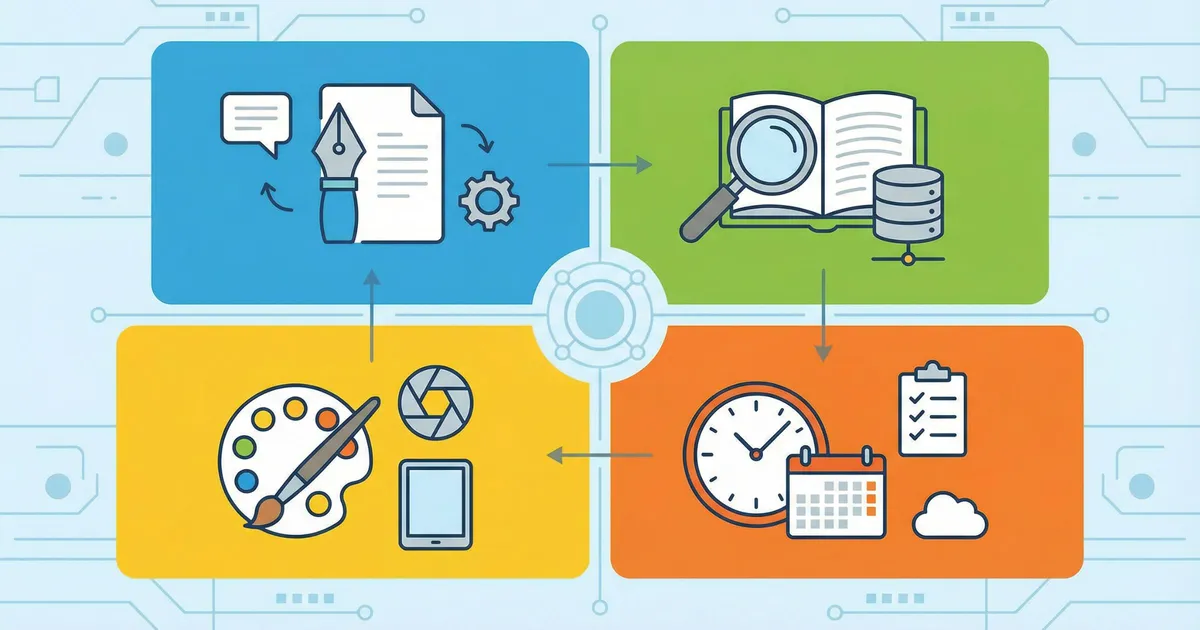
Using a single AI tool limits potential benefits. Combining writing, design, and research tools creates balanced workflows. For example, users can research topics, draft content, edit language, and design visuals using separate platforms. This modular approach improves quality.
Free AI ecosystems work best when tools complement each other. Writing assistants handle structure, editors improve clarity, and design tools enhance presentation. Research tools ensure accuracy. Together, they support professional outcomes.
Planning workflows improves efficiency. Understanding each tool’s strengths avoids redundancy. Responsible use ensures ethical content creation. This strategy maximizes value without cost.
Common Mistakes When Using Free AI Tools
One common mistake is expecting AI to produce perfect results without review. AI outputs require human judgment and editing. Blind trust can lead to errors or misinformation.
Another mistake involves overusing multiple tools without a clear workflow. Too many platforms create confusion rather than efficiency. Choosing a small, reliable set works better.
Ignoring privacy policies is also risky. Users should avoid sharing sensitive personal information. Understanding data usage protects security and trust.
Finally, relying entirely on AI can limit skill development. AI should enhance learning, not replace it. Balanced use leads to better long-term growth.
Frequently Asked Questions
Are free AI tools reliable in 2026?
Yes, many free tools now offer stable and accurate performance for everyday tasks.
Can free AI tools replace paid software?
They can handle basic needs but may lack advanced customization.
Are free AI tools suitable for students?
Yes, they are widely used for research, writing, and learning support.
Is AI-generated content allowed online?
Yes, when reviewed, edited, and used responsibly.
Do free AI tools store user data?
Most platforms explain data usage clearly in their privacy policies.
Conclusion
Free AI sites in 2026 offer powerful capabilities once limited to expensive software. They support writing, design, research, and productivity across personal and professional contexts. With thoughtful use, these tools deliver real value without financial barriers.
Success depends on choosing reliable platforms and using them responsibly. AI works best as a supportive partner rather than a replacement for human thinking. Editing, judgment, and creativity remain essential.
By building a simple, focused AI toolkit, users can improve efficiency and skills. Free AI has become a practical everyday assistant. Used wisely, it opens doors to learning, creativity, and growth.
Never Miss an Update
Join thousands of readers getting the latest insights on technology, business, and digital marketing.