What Is RSOC? The Publisher Revenue Model Explained
RSOC ads can deliver 3-5x higher CPMs than display. Discover how Related Search On Content works, why publishers are switching, and how to get started.
Minhaj Sadik

• RSOC ads show search-style results within content, delivering CPMs 3-5x higher than traditional display • Publishers need quality content, clean traffic, and approval from RSOC networks like System1, Tonic, or Sedo • Best-performing sites combine informational content with commercial search intent topics
Too long? Ask AI to summarize
Get a quick summary of this article using your favorite AI assistant
The Revenue Problem Most Publishers Don't Talk About
Why Your Display Ads Aren't Paying What They Used To
Here's something I hear constantly from publishers: "My traffic is growing, but my revenue is flat."
Sound familiar? You're not imagining it. Display ad CPMs have been in decline for years. Banner blindness is real—studies show users consciously or unconsciously ignore banner-like content 86% of the time. Meanwhile, ad blockers now run on over 42% of browsers worldwide, according to Statista's 2023 report.
The math simply doesn't work anymore for many publishers relying solely on traditional display.
But there's a monetization model that's been quietly generating serious revenue for publishers in the know. It's called RSOC—Related Search On Content—and it's reshaping how smart publishers think about making money online.
I'm going to break down exactly what RSOC is, how it works, why it typically pays more than display, and whether it's right for your site. No fluff. No hype. Just the practical stuff you need to decide if this belongs in your monetization strategy.
What RSOC Actually Means (Plain English Version)
RSOC stands for Related Search On Content. Sometimes you'll see it called "search feed monetization" or "native search ads."
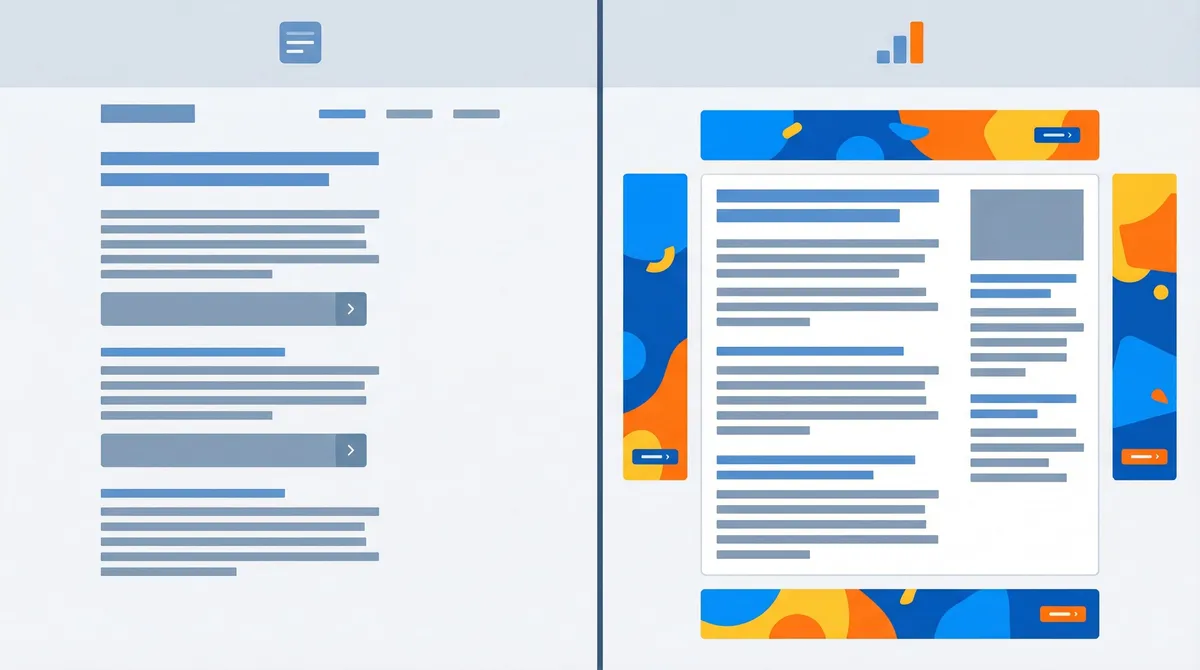
Here's the simple explanation: Instead of showing banner ads around your content, you display search-style ad units within your content. These look like the sponsored results you'd see on Google—text links with small descriptions, grouped by topic.
When a reader clicks one of these search-style links, they're taken to a search results page filled with ads from major search engines (usually Bing or Yahoo through partnerships). The advertiser pays for that click, the search engine takes a cut, the RSOC network takes a cut, and you—the publisher—get paid.
Why does this matter? Because search ads pay on intent. Someone searching for "best credit cards" is further along in the buying journey than someone casually reading an article. Advertisers pay premium rates for search clicks. And RSOC lets you capture some of that search ad revenue.
The global search advertising market represents $279.3 billion in spending according to eMarketer's 2024 forecast. RSOC gives publishers a way to tap into that pool rather than competing for shrinking display budgets.
Understanding the RSOC Ecosystem
How RSOC Revenue Actually Flows
Let me walk you through what happens when a reader interacts with RSOC ads on your site.
Step 1: Reader lands on your content.
They're reading your article about, say, home insurance options. Your page includes an RSOC widget—usually positioned mid-article or at the bottom.
Step 2: RSOC unit displays contextual search links.
The network's algorithm scans your content and serves search-style links related to the topic. For your insurance article, the unit might show links like "Compare Home Insurance Quotes" or "Top-Rated Insurance Providers 2024."
Step 3: Reader clicks a link.
They're interested, so they click. This takes them to a search results page—not your page anymore—filled with paid search ads from advertisers bidding on those keywords.
Step 4: Revenue is generated and split.
The search engine (Bing, Yahoo) pays the RSOC network for delivering that click. The network pays you a percentage—typically 50-70% of the click value.
The key difference from display: You're not being paid for impressions. You're being paid for clicks on high-intent search keywords. And those keywords—especially in finance, insurance, legal, and health—can pay anywhere from $0.50 to $15+ per click.

The Networks Behind RSOC
RSOC isn't something you get directly from Google or Bing. It flows through specialized networks that have direct partnerships with the search engines.
Major RSOC networks include:
System1 — One of the largest players, powering search monetization for major publishers
Tonic/Ads.com — Popular with content arbitrage publishers, known for fast approvals
Sedo — Strong in domain monetization and parked page RSOC
Domain Active — Focuses on direct navigation and type-in traffic
bodis — Another domain-focused option with RSOC capabilities
Each network has different requirements, payout thresholds, and revenue share structures. Some require premium traffic quality. Others work with newer publishers. I'll cover how to get approved in our /blog-monetization — blog monetization guide.
RSOC vs. Traditional Display: Real Numbers
Let's get specific about why publishers switch.
Metric | RSOC Ads | Display Ads |
|---|---|---|
Average CPM | $15-80+ | $1-10 |
Revenue Model | Per click (CPC) | Per impression (CPM) |
User Intent | Higher (search behavior) | Lower (passive viewing) |
Placement | Within content | Around content |
Ad Blocker Impact | Lower | Higher |
User Experience | Text-based, less intrusive | Visual, can feel cluttered |
Those CPM numbers deserve context. RSOC "CPMs" are calculated based on the CPC you receive multiplied by your click-through rate. A finance site getting $3 per click with a 2% CTR would see an effective CPM of $60. Compare that to the $2-5 display CPMs many publishers report, and you see why RSOC gets attention.
The catch? Not every click pays $3. Actual per-click revenue depends entirely on the keywords your content triggers and the advertiser demand for those terms. Some niches—travel, education, local services—perform well. Others barely move the needle.
Why RSOC Outperforms (And When It Doesn't)
The Intent Advantage Explained
Here's the thing about advertising: intent is everything.
When someone searches "best CRM software for small business" on Google, they're actively looking to buy or at least evaluate options. Advertisers will pay $10, $20, even $50+ for that click because the conversion potential is massive.
Compare that to the same person scrolling past a banner ad for CRM software while reading a news article. They weren't looking for software. They were looking for news. The click probability is low. The conversion probability is lower. So advertisers pay less—way less.
RSOC works because it catches users at a moment of engagement. They're reading your content. The content is about a specific topic. The RSOC unit shows search-style links related to that topic. If the reader clicks, they've demonstrated active interest.
It's not as strong as someone searching on Google directly. But it's significantly stronger than a random banner impression. That's why the CPCs are higher than display CPMs.

The Content Types That Work Best
Not all content performs equally with RSOC. Through my experience and industry data, certain patterns emerge.
High-performing content:
How-to guides with commercial undertones (how to start a business, how to improve credit score)
Comparison articles (best X vs Y, top 10 products)
Problem-solution content (fix X issue, solve Y problem)
Location-based guides (best restaurants in [city], things to do in [area])
Finance, insurance, legal, health, education, and B2B topics
Lower-performing content:
Pure entertainment (celebrity gossip, viral content)
Breaking news without commercial angles
Highly specialized niche topics with low advertiser demand
Content targeting very young demographics (lower purchase intent)
If your site focuses on informational content with implicit commercial intent—topics people research before spending money—RSOC can be transformational. If you run a meme site, probably not.
The Downsides Nobody Mentions
I'll be straight with you: RSOC isn't a magic money button. There are legitimate reasons it might not work for you.
User experience trade-offs. RSOC units take readers away from your site. Unlike display ads where users click and return, RSOC clicks send readers into a search funnel. High click rates might mean lower time on site and fewer pageviews. You're trading engagement for revenue.
Approval isn't guaranteed. Major RSOC networks are picky. They want quality content, legitimate traffic sources, and sites that won't generate fraud complaints. If your traffic is bot-heavy or comes from questionable sources, expect rejection.
Revenue volatility. RSOC earnings fluctuate more than display. Advertiser budgets shift seasonally. Your click rates change based on content mix. One month might be incredible, the next disappointing. It's harder to forecast.
Compliance requirements. Search engines providing the ad inventory have strict policies. Incentivizing clicks, misleading placements, or policy violations can get you banned—fast. And bans can be permanent.
For most established publishers, these trade-offs are manageable. But go in with realistic expectations.
Getting Started With RSOC Monetization
What You Need Before Applying
RSOC networks evaluate applications carefully. Before you apply, make sure you have:
Quality content. At least 20-30 articles of original, substantial content. Thin pages or AI-generated content with no editing will get flagged. Networks want publishers who add value.
Clean traffic sources. Organic search, social, direct, and referral traffic from legitimate sources. If you're buying traffic, be extremely careful—incentivized or bot traffic will disqualify you immediately and possibly blacklist your domain.
Professional site design. Your site should look trustworthy. Working navigation, clear branding, functional mobile experience, proper SSL certificate. First impressions matter in approvals.
Policy-compliant content. No content that violates major ad network policies. That means nothing involving prohibited topics which I won't list but you can find in the /faq — SearchDrive FAQ.
Privacy essentials. Privacy policy, terms of service, and cookie consent mechanisms in place. Networks check for these.
If you're starting from scratch, expect 2-3 months of building before you're application-ready. If you have an established site with real traffic, you might be approved quickly.

Placement Strategies That Actually Work
Where you put RSOC units matters enormously.
Mid-content placement typically performs best. After readers consume significant content—around the 40-60% scroll depth point—they've demonstrated engagement. An RSOC unit here catches them at peak interest. Some publishers see 30-50% higher CTRs with mid-content versus bottom-only placements.
Exit-intent positioning works for some sites. When a user is about to leave anyway, presenting relevant search options can capture that last click. This approach feels less intrusive since you're not interrupting the reading experience.
Related content sections offer another option. Placing RSOC alongside "read more" recommendations creates a mixed unit where users explore either more content or search topics. This balances monetization with engagement.
What to avoid: Don't put RSOC units above the fold or before any real content. This looks spammy, frustrates users, and can trigger network compliance reviews. The networks themselves will warn you against this—their partners (the search engines) hate it.
The Application Process Step-by-Step
Choose your target network. Research options, read publisher reviews, and pick 1-2 networks appropriate for your traffic level. System1 and Tonic are common starting points.
Complete their application. You'll provide your domain, traffic estimates, content description, and contact information. Be honest—they verify claims.
Wait for review. This takes anywhere from 48 hours to 2 weeks depending on the network. Some request additional information or calls.
Integration if approved. You'll receive code or access to their publisher dashboard. Implementation varies—some use JavaScript widgets, others require WordPress plugins or API integration.
Test and optimize. Start with modest placements. Monitor performance. Adjust positions based on data.
For a deeper walkthrough, check our guide on /make-money-online — making money online with content sites.
Advanced RSOC Strategies
Content Strategy for Maximum RSOC Revenue
If you're serious about RSOC, your content strategy should factor in monetization potential.
This doesn't mean writing only for money. It means, given two equally interesting topics to cover, understanding which one might also generate revenue.
Keyword research with CPC data. Tools like Ahrefs, SEMrush, or even Google Keyword Planner show estimated cost-per-click for keywords. Topics with higher CPCs—generally finance, insurance, legal, B2B software—will generate more RSOC revenue per click.
I ran numbers on this for a test site. Articles about "best accounting software" earned roughly $4.20 per RSOC click. Articles about "best hiking trails" earned $0.35. Same traffic quality, same click rates, dramatically different revenue. The advertisers bidding on accounting software simply pay more.
Search intent alignment. Write content that naturally leads to commercial exploration. A guide titled "How to Choose a Business Bank Account" creates perfect context for RSOC units about business banking. The reader is literally researching before a purchasing decision.
Evergreen over trending. News content generates traffic spikes but has short monetization windows. Evergreen content about perennial topics—insurance explained, financial planning basics, software comparisons—continues generating RSOC clicks for months or years.
Traffic Source Optimization
Not all traffic monetizes equally.
Organic search visitors typically perform best. They arrived through a search—they're already in a searching mindset. Clicking additional search-style links feels natural. These visitors often generate the highest RSOC click rates.
Social traffic varies widely. Pinterest visitors researching projects convert well. Twitter visitors reading commentary less so. Facebook traffic is highly dependent on the content type and audience demographics.
Paid traffic is tricky. RSOC networks allow it, but you're essentially doing arbitrage—buying visitors for less than the RSOC revenue they generate. This works when done carefully, fails spectacularly when done poorly. If you're interested in this model, search arbitrage deserves its own deep dive (coming in this series).
Direct traffic from loyal readers often monetizes poorly. They came for your content specifically, not to explore search topics. Don't expect high click rates from newsletter subscribers or returning visitors.
Understanding your traffic mix helps forecast realistic RSOC revenue and identify optimization opportunities.
Common Mistakes That Kill RSOC Revenue
After watching publishers implement RSOC for years, certain patterns emerge.
Mistake #1: Misleading unit styling. Making RSOC units look like your content or hiding the "sponsored" designation seems clever until you get banned. Networks conduct audits. Violations mean termination.
Mistake #2: Too many units. Cramming RSOC into every possible position destroys user experience and dilutes performance. One well-placed unit often outperforms three poorly-placed ones.
Mistake #3: Wrong content match. Placing RSOC on content with zero commercial intent wastes positions. Your personal essay about morning routines won't generate quality clicks no matter where you put the unit.
Mistake #4: Ignoring data. RSOC dashboards show which pages perform, which don't, and why. Publishers who check weekly and adjust beat those who set-and-forget.
Mistake #5: Single network dependence. Working with multiple RSOC networks (where allowed) provides backup if one network changes terms, reduces payments, or terminates relationships. Diversification protects revenue.
The Bigger Picture for Publishers
Where RSOC Fits in Your Monetization Stack
RSOC works best as part of a diversified approach. Here's how I typically recommend publishers think about it:
Display ads for general impressions and broad monetization across all content types. Platforms like Google AdSense or Mediavine provide baseline revenue.
RSOC for commercial-intent content where search behavior makes sense. Layer it on top of display or use it as primary monetization for specific sections.
Affiliate marketing for product-focused content where you can recommend specific solutions. Captures higher value but requires more work per piece.
Sponsored content for premium partnerships and brand deals. Highest revenue per post but least scalable.
Premium memberships if your audience values exclusive access enough to pay. Requires significant audience loyalty.
Most successful publishers I know use 2-3 of these simultaneously. RSOC plus display is common. RSOC plus affiliate on product content works well. The right mix depends on your content focus and audience.
For a complete breakdown of monetization methods, see our /how-it-works — how SearchDrive works page.
What's Next for Search Monetization
The RSOC space continues evolving. A few trends worth watching:
AI content evaluation is getting stricter. Networks are using AI to assess content quality, and low-effort AI-generated sites are being rejected at higher rates. Human editing and genuine expertise matter more.
Privacy changes affect targeting. Third-party cookie deprecation impacts display advertising heavily. Search-style ads, which rely less on tracking and more on contextual relevance, may benefit comparatively.
Mobile optimization is mandatory. With over 60% of web traffic on mobile devices, RSOC units that perform poorly on small screens hurt revenue. Responsive design isn't optional.
Quality requirements are increasing. Both search engines and RSOC networks are tightening approval standards. Sites that barely qualified two years ago might not make the cut today.
The publishers who invest in genuine quality—good content, clean traffic, professional sites—will continue accessing RSOC revenue. Those trying to game the system will find doors closing.
Frequently Asked Questions
RSOC means Related Search On Content. It's an advertising format where search-style ad units appear within web content, showing links relevant to the page topic. Clicking these links generates revenue for the publisher.
Never Miss an Update
Join thousands of readers getting the latest insights on technology, business, and digital marketing.